
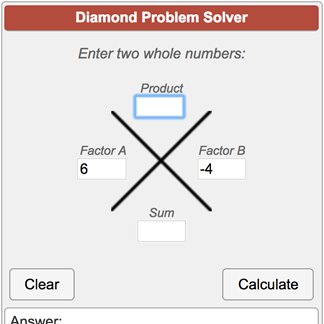
Efficient Diamond Problem Solver Guide
Struggling to navigate the diamond problem in your code? Look no further – the diamond problem solver is here to rescue your programming woes. Solving…
Struggling to navigate the diamond problem in your code? Look no further – the diamond problem solver is here to rescue your programming woes. Solving conflicts in multiple inheritance scenarios can be tricky, but with the right approach, you can untangle the confusion. By understanding how the diamond problem arises and implementing proper resolution techniques, you’ll be on your way to cleaner, more efficient code in no time. Let’s delve into the world of the diamond problem and emerge victorious with our adept problem-solving skills.

The Amazing Diamond Problem Solver: A Sparkling Solution for Your Mathematical Puzzles
Welcome, young mathematicians, to the world of the diamond problem solver! Have you ever encountered a challenging math puzzle that seemed impossible to crack? Well, fear not, because the diamond problem solver is here to help you shine bright like a diamond in your mathematical journey. In this blog article, we will delve into the fascinating world of diamond problem solving, exploring its origins, principles, and practical applications. So, put on your thinking caps and get ready to unlock the secrets of the diamond problem solver!
What is the Diamond Problem Solver?
The diamond problem solver is a powerful mathematical tool that helps you unravel complex puzzles by breaking them down into simpler parts. Imagine you have a challenging math problem that seems overwhelming at first glance. The diamond problem solver acts as your guide, leading you through a structured process to find the solution step by step. By using logical reasoning and critical thinking skills, you can navigate through the problem-solving process with ease and confidence.
Origins of the Diamond Problem Solver
The concept of the diamond problem solver can be traced back to ancient civilizations where mathematicians and scholars devised creative methods to solve intricate mathematical puzzles. Over the centuries, the principles of problem-solving have evolved and expanded, giving rise to various techniques and strategies used in modern mathematics.
Today, the diamond problem solver is a popular tool employed in educational settings to enhance students’ problem-solving skills and foster a deeper understanding of mathematical concepts. By engaging with challenging puzzles and applying the diamond problem-solving approach, students can develop critical thinking abilities, logical reasoning skills, and a resilient mindset when faced with complex problems.
How Does the Diamond Problem Solver Work?
Now that you have a basic understanding of what the diamond problem solver is, let’s delve into how this magical tool actually works. The diamond problem solver follows a systematic approach to problem-solving that involves several key steps:
Step 1: Identify the Problem
The first step in using the diamond problem solver is to clearly identify the problem you are trying to solve. Take a moment to read the problem carefully, understand the given information, and define the key elements involved. By breaking down the problem into manageable parts, you can gain a clearer perspective on what needs to be solved.
Step 2: Analyze the Problem
Once you have identified the problem, the next step is to analyze it thoroughly. Look for patterns, relationships, and clues that can help you formulate a plan of action. Consider different approaches to solving the problem and choose the strategy that best fits the context of the puzzle. By applying critical thinking skills and logical reasoning, you can begin unraveling the mystery surrounding the problem.
Step 3: Develop a Solution Strategy
After analyzing the problem, it’s time to develop a solution strategy. This involves outlining a step-by-step plan to tackle the problem methodically. Break down the problem into smaller sub-problems and identify the tools or techniques you can use to solve each part. By organizing your thoughts and formulating a clear strategy, you can approach the problem with confidence and precision.
Step 4: Implement the Solution
With a solid solution strategy in place, it’s time to put your plan into action. Follow the steps outlined in your strategy, working through each part of the problem methodically. Keep track of your progress, make adjustments as needed, and stay focused on your ultimate goal of finding the solution. By staying organized and disciplined in your approach, you can overcome any challenges that come your way.
Practical Applications of the Diamond Problem Solver
The diamond problem solver is not just a theoretical concept – it has real-world applications that extend beyond the realm of mathematics. In fact, problem-solving skills are highly valued in various fields, including science, technology, engineering, and even everyday life. By mastering the art of problem-solving with the diamond problem solver, you can enhance your cognitive abilities and become a more effective problem-solver in any situation.
Mathematics
In mathematics, the diamond problem solver is a valuable tool for tackling complex equations, geometric problems, and algebraic puzzles. By applying the principles of problem-solving, students can sharpen their mathematical skills and deepen their understanding of mathematical concepts. Whether you’re solving for x in an algebraic equation or finding the area of a geometric shape, the diamond problem solver can help you approach the problem with confidence and clarity.
Science
In the field of science, problem-solving skills are essential for conducting experiments, analyzing data, and drawing conclusions. Scientists use critical thinking and logical reasoning to solve complex problems and make innovative discoveries. By honing your problem-solving abilities with the diamond problem solver, you can excel in science-related activities and contribute to advancements in various scientific disciplines.
Technology
Technology is another area where problem-solving plays a crucial role. From coding and programming to troubleshooting technical issues, technology professionals rely on problem-solving skills to overcome challenges and create innovative solutions. By mastering the art of problem-solving with the diamond problem solver, you can enhance your technical abilities and excel in the ever-evolving field of technology.
Congratulations, young mathematicians, you have now unlocked the secrets of the diamond problem solver! By mastering the art of problem-solving with this powerful tool, you can tackle any mathematical puzzle with confidence and perseverance. Remember, the key to successful problem-solving lies in patience, practice, and a positive attitude. So, keep shining bright like a diamond in your mathematical journey, and never be afraid to face challenges head-on. Happy problem-solving!
Thank you for joining us on this exciting adventure into the world of the diamond problem solver. We hope you have gained valuable insights and inspiration to excel in your mathematical pursuits. Stay curious, stay determined, and never stop exploring the wonders of mathematics!
Until next time, happy problem-solving!
How to solve diamond problems
Frequently Asked Questions
How does the diamond problem occur in programming?
The diamond problem occurs in programming when a class inherits from two separate classes that have a common ancestor. This results in ambiguity for the compiler when it comes to accessing shared members or methods between the two parent classes.
What is the impact of the diamond problem on code functionality?
The diamond problem can lead to conflicts in the code, as the compiler may not be able to determine which version of an inherited method or attribute to use. This can result in unexpected behavior, compilation errors, or runtime issues, making the code difficult to maintain and debug.
How can the diamond problem be resolved in programming?
The diamond problem can be resolved in programming by using virtual inheritance, a feature that allows the common ancestor class to be inherited only once by the derived classes. This ensures that there is only one instance of the shared members, eliminating the ambiguity and conflicts that arise from multiple inheritance.
Final Thoughts
The diamond problem solver is a versatile tool that effectively resolves complex issues in software development. With its ability to handle conflicting methods and dependencies, it streamlines the coding process and enhances efficiency. Embracing this approach empowers developers to navigate intricate programming challenges with ease. Mastering the diamond problem solver technique equips professionals with a valuable skill set that sets them apart in the competitive tech industry. Ultimately, adopting this strategy propels projects forward and ensures successful outcomes.